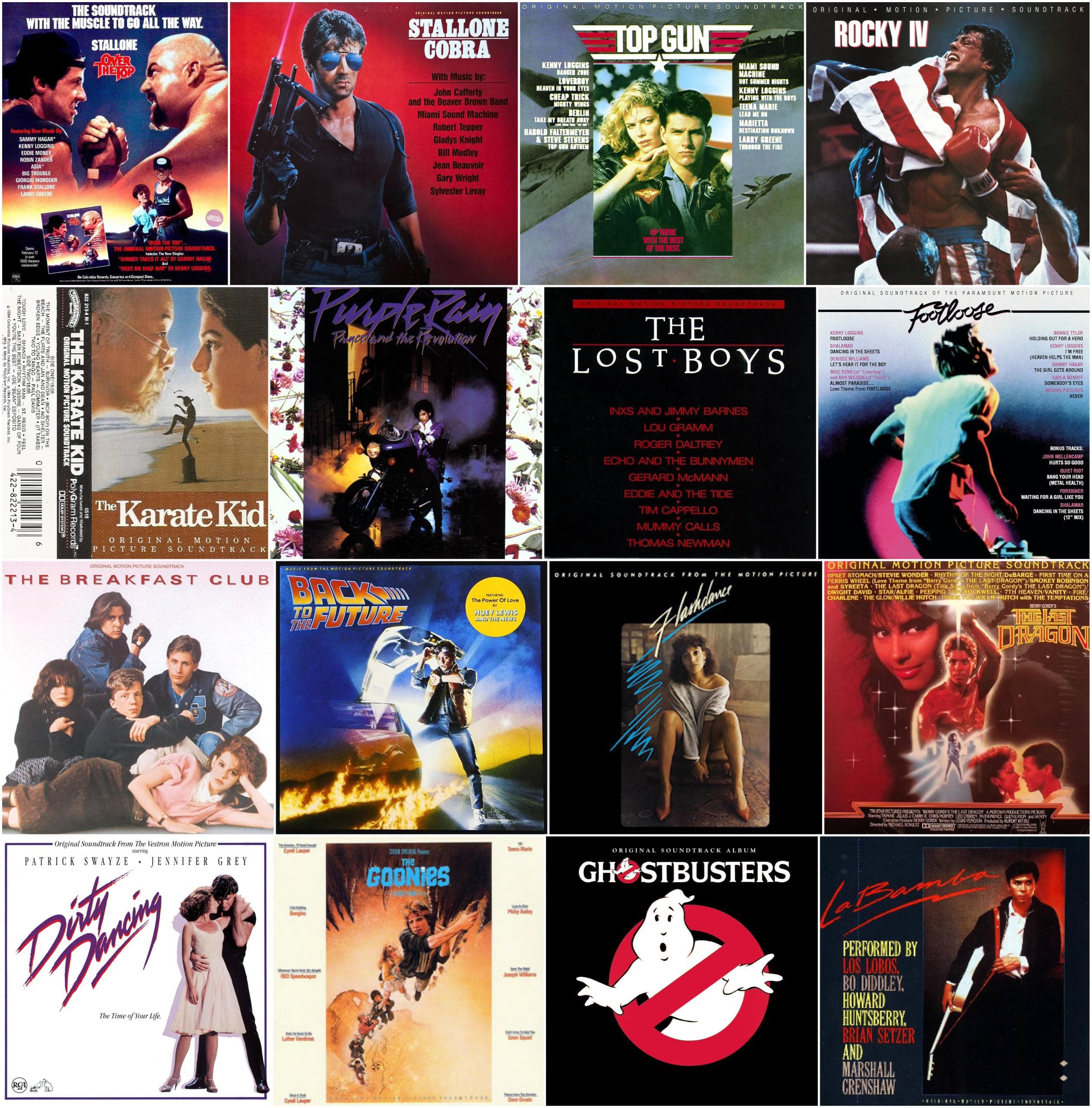
The Greatest Movie Soundtracks of the 80s
The decade when a movie soundtrack could become almost as famous as the film itself.
PRESS PLAY
When the soundtrack was almost as important as the movie
There are some 80s movies you don't even have to see to remember them. You just have to hear them.
A few seconds of a song can put you straight back inside a film you haven't watched for twenty years. Suddenly Maverick is climbing into an F-14, Kevin Bacon is dancing out his frustration in a warehouse, and Marty McFly is desperately trying to get a DeLorean up to 88 miles per hour.
That's the thing about 80s movie soundtracks. They weren't always just music playing behind the action. They became part of the identity of the film.
Sometimes the soundtrack sold the movie. Sometimes the movie sold the soundtrack. And occasionally the two became so tangled together that it's now almost impossible to think about one without hearing the other.
The 1980s were absolutely bloody brilliant at that.
TOP GUN
Top Gun turned a soundtrack into a cultural event
If you wanted to explain the power of an 80s soundtrack using one movie, Top Gun would make a very strong case.
Kenny Loggins' Danger Zone doesn't merely accompany the film. It announces it. Those opening carrier-deck images, the jets, the orange sky and that music immediately tell you exactly what sort of movie you're about to watch.
Then Berlin's Take My Breath Away gives the film its other musical identity. One soundtrack manages to sell both the testosterone-fuelled fantasy of being a fighter pilot and the enormous romantic melodrama at the centre of the story.
That's pure 1986. Subtlety can wait outside.
Top Gun understood that a huge pop soundtrack could make a movie feel bigger than the screen it was playing on.
PURPLE RAIN
Purple Rain made separating the movie and album almost impossible
Then you have Purple Rain, where calling the music a soundtrack almost feels inadequate.
Prince didn't simply provide songs for a movie. The music is the reason the movie exists in the form it does.
Let's Go Crazy, When Doves Cry and Purple Rain aren't little musical decorations added afterwards. They're woven into the film's identity, performance and emotion.
And that relationship worked both ways. The movie gave the songs images, characters and a mythology, while the album gave the movie a cultural life far beyond the cinema.
Few films demonstrate the 80s relationship between movies, music and image more completely.
FOOTLOOSE
Footloose basically arrived with its own jukebox
Footloose is another film where the soundtrack isn't optional.
Kenny Loggins' title track is so thoroughly attached to the movie that hearing the opening seconds practically makes your feet expect a pair of dancing shoes to appear on screen.
But the film wasn't built around a single hit. Holding Out for a Hero, Let's Hear It for the Boy and Almost Paradise helped turn the soundtrack into a parade of songs that could live independently on radio and television.
That's something the decade became incredibly good at: making a film soundtrack feel almost like a greatest-hits album that happened to come with a movie attached.
And in Footloose, where dancing and music are fundamental to the story anyway, the approach fits perfectly.
DIRTY DANCING
Dirty Dancing proved nostalgia could have a soundtrack too
Dirty Dancing pulled off a slightly different trick.
The movie is set in 1963, but its soundtrack became an enormous part of 1987 pop culture. Older songs sit alongside new recordings, creating something that belongs simultaneously to the period of the story and the decade in which the movie was released.
(I've Had) The Time of My Life became inseparable from that final dance. Hungry Eyes became inseparable from the romance. The music doesn't simply remind you of the film; for many people, it reminds them of seeing the film for the first time.
That's when a soundtrack becomes something more powerful than a collection of songs.
It becomes a memory trigger.
THE LOST BOYS
The Lost Boys sounded exactly like it looked
Few soundtracks capture the atmosphere of their movie as perfectly as The Lost Boys.
The whole film feels like somebody poured 1987 into a bottle: motorcycles, leather jackets, neon, amusement parks, enormous hair and vampires who look considerably cooler than anyone trying to kill them.
And then there's Cry Little Sister.
That song doesn't just belong to The Lost Boys. It feels as though it could only exist inside The Lost Boys.
Add tracks like Good Times and that gloriously excessive version of I Still Believe and the soundtrack becomes another part of Santa Carla itself.
You don't just remember what The Lost Boys looked like. You remember what it sounded like.
BACK TO THE FUTURE
Back to the Future knew exactly when to turn up the volume
Back to the Future had something slightly different going on because Alan Silvestri's enormous orchestral score does so much of the heavy lifting.
But the film also understood the sheer usefulness of a great pop song.
Huey Lewis and the News gave it The Power of Love, a song that became permanently attached to Marty McFly, skateboards and Hill Valley even though it isn't remotely about time travel.
Then the movie travels back to 1955 and gets to have even more fun with music, culminating in Marty introducing a bewildered school dance to a version of rock and roll they're apparently not quite ready for.
It's another example of an 80s film using music not as background decoration but as part of its personality.
BEVERLY HILLS COP
Sometimes an instrumental was all you needed
Not every defining piece of 80s movie music needed somebody singing over it.
Harold Faltermeyer's Axel F is proof.
Those synthesiser notes became so closely associated with Beverly Hills Cop that they practically function as another character in the movie.
And it sounds gloriously of its time. There's no attempt to hide the technology or make the music timeless. It's electronic, playful and unmistakably 1980s.
That's part of its charm. The decade wasn't embarrassed by synthesizers. It handed them the keys to the bloody soundtrack department.
GHOSTBUSTERS
And sometimes the theme song became bigger than anyone expected
Then there's Ghostbusters.
Ray Parker Jr.'s title song is one of those pieces of movie music that escaped the film almost immediately and became part of popular culture in its own right.
You don't need to explain what movie it's from. You barely need to say the title.
Someone asks who you're going to call and an entire generation knows the answer.
That's the dream scenario for a movie theme: something catchy enough to work away from the cinema while remaining permanently connected to the film that created it.
THE BREAKFAST CLUB
One song could own the final scene
The Breakfast Club demonstrates another great 80s soundtrack trick: save exactly the right song for exactly the right moment.
Simple Minds' Don't You (Forget About Me) and John Bender's raised fist are now effectively one memory.
Take away the song and the ending still works. Add the song and it becomes iconic.
That's what the best soundtrack choices do. They don't merely accompany an emotion that's already there. They amplify it until the scene and the music become permanently joined together.
Decades later, hearing that song can still conjure the image before you've consciously thought about the movie.
FLASHDANCE
MTV and Hollywood were suddenly speaking the same language
Flashdance arrived just as music video culture was changing the way popular music looked.
That made cinema and MTV natural partners.
What a Feeling and Maniac weren't simply successful songs attached to a successful film. The musical sequences themselves had the energy and visual immediacy of music videos.
Hollywood had discovered that a movie could generate scenes people wanted to see repeatedly outside the movie, while a hit song could effectively advertise the film every time it played on the radio or television.
By the middle of the decade, that relationship had become incredibly powerful.
BEYOND THE POP SONGS
The 80s also gave us some enormous movie scores
Of course, reducing 80s movie music to pop soundtracks would ignore half the story.
This was also a decade of magnificent scores.
John Williams gave Indiana Jones one of cinema's great adventure themes. John Carpenter's electronic music became inseparable from films like Escape from New York. Vangelis helped make Blade Runner sound as strange, melancholy and futuristic as it looked.
Alan Silvestri made Back to the Future feel like the biggest adventure imaginable, while Danny Elfman's Batman score helped give Gotham a dark, theatrical identity of its own.
The instruments and approaches varied wildly, but the best scores shared something with the great pop soundtracks: personality. You knew what movie you were listening to.
THE CASSETTE GENERATION
We took the movies home in our Walkmans
There's another reason these soundtracks became so important: you could take a piece of the movie home with you.
Before you could instantly pull up a favourite scene whenever you wanted, owning the soundtrack was a different kind of connection to a film.
You bought the record or cassette. You played it in the car. You put it in your Walkman. You made copies for friends. The music kept the movie alive long after you'd left the cinema or returned the VHS to the video shop.
For younger audiences especially, the soundtrack could become part of everyday life in a way the movie itself couldn't.
That helped turn certain films from things we'd watched into things we felt we somehow owned.
THE LEGACY
Why these soundtracks still hit so hard
Nostalgia obviously plays a part. We're not going to pretend otherwise.
But nostalgia alone doesn't explain why so many of these songs and scores continue to work.
The great 80s soundtracks had identity. They weren't afraid of sounding enormous, emotional, electronic, cheesy, romantic or completely excessive.
More importantly, the best music was attached to moments worth remembering.
A jet taking off. A fist raised into the air. A dance finally completed. A skateboard grabbing the back of a car. A vampire stalking a neon boardwalk.
The image gives you the music. The music gives you the image.
ONE MORE TRACK
The 80s didn't believe in background music
That's ultimately what made the decade's greatest movie soundtracks so special.
The music wasn't expected to sit quietly in the corner and behave itself.
It was allowed to be huge.
Top Gun wanted you to remember Danger Zone. The Breakfast Club wanted you to leave the cinema hearing Don't You (Forget About Me). The Lost Boys wanted Cry Little Sister following you all the way home.
And forty years later, it still works.
Put on the right song and we're back there instantly.
No DeLorean required.
Keep reading
More features
Movies
10 Movies That Defined 1985
From time machines to pirate treasure, 1985 might have been one of the most ridiculously entertaining years in movie history.
Read the feature →
Horror
Why 80s Vampire Movies Were So Damn Good
The decade gave vampires leather jackets, nightclubs, motorbikes and a completely new attitude.
Read the feature →