// The setup
PLAYBACK STARTED
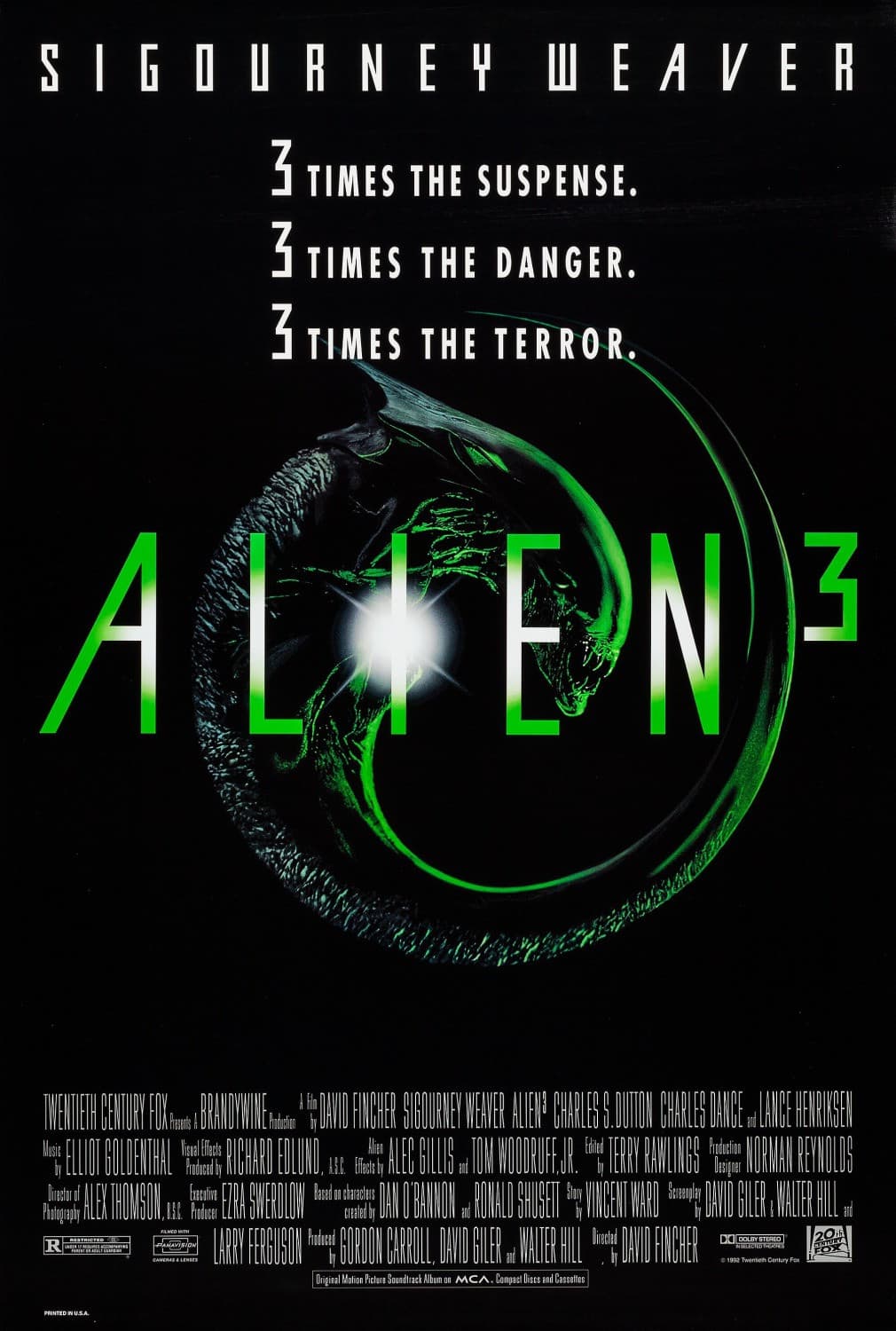
After the relentless action of Aliens, the third chapter takes Ellen Ripley somewhere colder, bleaker and far more unforgiving. Stranded among the inmates of an isolated prison facility and stripped of the firepower that helped her survive before, Ripley discovers that the nightmare she thought she had escaped has followed her once again. David Fincher's feature directorial debut remains one of the most debated entries in the Alien saga: a grim, uncompromising film shaped by a famously difficult production but filled with striking imagery, powerful performances and one of Sigourney Weaver's most committed turns as Ripley.
THE NIGHTMARE CONTINUES
Ripley Wakes Up in Another Hell
The story begins after Aliens. An emergency aboard the Sulaco sends an escape vehicle crashing onto Fiorina “Fury” 161, a bleak industrial facility populated by male prisoners.
Ripley is the sole survivor recovered from the wreckage.
Almost immediately, however, she suspects that she may not have arrived alone. The circumstances surrounding the crash and the deaths of those who travelled with her leave questions that Ripley understands better than anyone else.
She has seen what the Xenomorph can do. She also knows that ignoring the warning signs never ends well.
FURY 161
A Prison at the End of the Universe
Fiorina 161 gives Alien 3 an identity completely different from the military environments of Aliens.
The facility is decaying, isolated and populated by inmates who have developed their own strict religious community. There are no squads of heavily armed Colonial Marines waiting to fight whatever appears.
That becomes crucial when the creature begins hunting.
Ripley and the prisoners are forced to confront it with little more than their knowledge of the facility, improvised plans and the willingness to put themselves directly in its path.
The result brings the series closer to the vulnerability of the original Alien: ordinary people trapped in an enclosed environment with something physically superior to them.
ELLEN RIPLEY
Sigourney Weaver Takes Ripley Somewhere Darker
By the third film, Ellen Ripley has endured more than almost any science-fiction protagonist should reasonably survive.
Alien 3 refuses to make that survival easy.
Sigourney Weaver plays Ripley with a weary determination that feels markedly different from the character audiences met aboard the Nostromo. She has already faced the creature twice, lost decades of her life and watched almost everyone around her die.
Yet when the threat returns, Ripley again becomes the person prepared to confront it.
Her shaved head became one of the film's defining visual images, but Weaver's performance matters far more than the change in appearance. This is a Ripley who understands exactly what the creature represents and increasingly understands what it may take to stop it.
NO GUNS. NO MARINES.
Fighting a Xenomorph With Almost Nothing
One of Alien 3's strongest ideas is removing the weaponry that dominated the previous film.
The Colonial Marines had pulse rifles, smart guns, flamethrowers and explosives.
The prisoners of Fury 161 have almost none of that.
Their battle therefore becomes a desperate attempt to use the prison itself as a weapon. Corridors, doors and industrial machinery become part of an improvised plan to trap and destroy an enemy capable of killing them in seconds.
This approach changes the film's rhythm. Instead of soldiers advancing into combat, frightened men must deliberately place themselves in danger to lure the creature where they need it to go.
A DIFFERENT BEAST
The Alien Changes Again
The creature stalking Fury 161 is noticeably different from those encountered in the previous films.
Lower to the ground and extraordinarily fast, this incarnation frequently moves on four limbs and hunts through the prison's tunnels and corridors with animal-like aggression.
That physicality gives the film some of its most memorable sequences as the creature tears through the facility while prisoners desperately attempt to execute their plan.
The Alien series had already demonstrated that the Xenomorph could change depending on circumstances. Alien 3 pushes that concept further, presenting another variation of the creature without losing the characteristics that make it instantly recognisable.
BEHIND THE CAMERA
David Fincher's Extraordinary First Feature
Looking back at Alien 3 is impossible without acknowledging its famously troubled production.
David Fincher was making his feature-film directing debut after establishing himself through commercials and music videos. He inherited a project that had already passed through numerous concepts, writers and creative directions before filming began.
Production pressures and disagreements continued throughout the shoot and post-production, and Fincher later distanced himself from the finished film.
That history has become almost as famous as the movie itself.
Yet viewed decades later, many characteristics associated with Fincher's subsequent career are already visible: oppressive environments, meticulous compositions, institutional distrust, and characters struggling against systems far larger than themselves.
THE ASSEMBLY CUT
A Film Reconsidered Over Time
Alien 3's reputation has changed considerably since 1992.
Its original theatrical release divided audiences, particularly because of decisions made almost immediately concerning characters who had survived Aliens. For viewers emotionally invested in the previous film, the opening alone could feel brutally dismissive.
Years later, an extended version commonly known as the Assembly Cut offered a substantially different presentation assembled from surviving material.
It restores and expands numerous scenes, develops the prison community more fully and changes elements of the creature's discovery and the attempts to capture it.
It does not erase the film's turbulent history, but it has helped encourage a wider reassessment of what Alien 3 was trying to accomplish.
THE FINAL CHOICE
Ripley Refuses to Become Their Weapon
Running throughout the Alien films is the unsettling reality that the human institutions surrounding Ripley can be almost as dangerous as the creature itself.
The company sees opportunity where Ripley sees catastrophe.
By the climax of Alien 3, that conflict becomes intensely personal. Ripley is faced with a choice involving not simply her own survival but whether the nightmare she has spent years fighting will finally become something humanity deliberately controls.
Her response provides one of the defining moments of the entire saga.
It turns the film's bleakness into something more purposeful: after everything taken from her, Ripley still controls the one decision that matters most.
LEGACY
The Alien Film That Refused to Play Safe
Alien 3 has never enjoyed the universally celebrated reputation of Alien or Aliens.
Perhaps it never could.
Instead of attempting to reproduce James Cameron's action spectacle, it strips Ripley back down, removes her weapons and allies, and places her in another hostile environment where survival becomes increasingly unlikely.
The production problems are visible, and some creative decisions remain controversial decades later. But underneath them is an ambitious, unusually sombre science-fiction horror film with a committed central performance and a visual identity of its own.
For a franchise built around survival, Alien 3 dared to ask what happens when surviving is no longer the only thing that matters.
Share this movie
// Keep watching
More movies from the 90s
If Alien 3 is your kind of movie, there's plenty more on the shelves worth rewinding.

1999 // VHS
10 Things I Hate About You
Sibling rules, a rooftop serenade and one very stubborn Kat — Shakespeare in a school corridor.

1999 // VHS
American Beauty
Lester Burnham, suburban rot and a midlife argument that still stings.

1999 // VHS
Any Given Sunday
Al Pacino's coach anchors the chaos of a film about football turned into product — loud, messy and oddly persuasive.