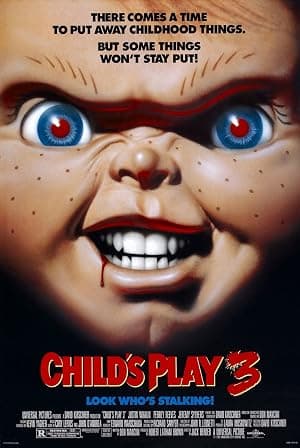
Child's Play 3
Bullying, boardrooms and a doll that won't let go.
// The setup
PLAYBACK STARTED
Child's Play 3 arrives like the grumpy older sibling of a franchise: same haunted child, same murderous doll, but transplanted into a military academy that treats trauma like bad behaviour. Jack Bender's entry keeps the premise tight — possession, a new host and a dozen ways for an animatronic nightmare to cause trouble — and Andy Barclay remains the film’s emotional compass.
THE MOVIE
Andy Barclay is still the reason this movie works
Child's Play 3 doesn’t rework the series so much as shift its chessboard. The film opens with Chucky being physically rebuilt at a toy plant — a rebirth that immediately sets him loose on the company and, crucially, points him back toward Andy.
By the time the story reaches Kent Military School, Andy is older, jumpy and boxed into a system that favours order over listening. That disciplinarian setting — bullies, strict officers and kids who don't understand him — is where the movie finds most of its tension.
It helps that the obvious roles are filled: Justin Whalin plays this older Andy, Brad Dourif returns as the voice that never stops scheming, and Jack Bender keeps the film compact and focused across a brisk 90 minutes.
THE SETUP
The idea that sets Child's Play 3 in motion
The engine is simple and mean in equal measure: a contaminated manufacturing process brings Chucky back, which immediately leads him to hunt down Andy using the company’s own records. It's a neat way of tying corporate machinery to supernatural nastiness.
What's different here is location and stakes. Andy is now a teenager at a military academy where the rules are rigid and the adults are not easily convinced. That structure gives the film clear obstacles beyond the obvious supernatural threat.
Chucky's aim is the same as ever — to survive by moving his soul into a living body — but the potential host this time is a younger cadet, which raises the game from personal revenge to a race to save another child.
Mechanically, the film leans on its set pieces: dorm life, staged war games and a purpose-built amusement-park finale that provide the frames for confrontation rather than sprawling new mythology.
THE CHARACTER
Why Andy Barclay matters
Andy is the spine of the movie. He’s not a blank-slate final girl or a bystander — he’s someone still chased by what happened to him, which changes how every adult and cadet reacts to him.
That haunted quality is what keeps the audience on Andy’s side when the military academy treats him like trouble rather than a boy in danger. The setup forces him to act without easy help, which sharpens the film’s conflicts.
Casting matters here only in so far as it serves the character: Justin Whalin steps into Andy’s older shoes after the earlier actor didn’t return, and the story insists on following this version of the character as he copes with past trauma while trying to protect someone younger.
THE PERFORMANCE
Why Brad Dourif's performance matters
One reliable through-line across the franchise is Chucky's voice: it anchors the doll’s personality and keeps the proceedings from dissolving into cartoonish slapstick.
Contemporary notices and later retrospectives frequently single out Dourif’s vocal work as a stabilising element — the voice that sells the malice and keeps the puppet credible.
Practically, Dourif recorded his lines before filming so the puppeteers could synchronise the doll’s mouth and facial movements to the recordings, which tightens the handoff between voice and animatronic expression.
So even when the script or staging falter, the voice reminds you what’s at stake: a small, obscene presence that won’t stop talking until it gets what it wants.
UNDER THE SURFACE
Child's Play 3 has more on its mind than the plot suggests
On the surface it’s a possession story: a murderous soul trying to jump bodies. Underneath, though, that movement of identity reads as an anxiety about who gets to belong in a world run by adults and corporations.
Andy’s ongoing trauma — being pursued and disbelieved — nudges the film toward an examination of how childhood wounds persist when institutions insist on neat categories like discipline and obedience.
Corporate commercialisation is literal here: a toy factory unintentionally recreates a killer. That connection — product, profit, contamination — gives the horror a modern, boardroom-adjacent bite.
And because much of the action happens inside a military academy, institutional authority becomes an antagonist in its own right: rules and rank complicate rescue and make disbelief a form of harm.
THE FILMMAKING
How Child's Play 3 was put together
The production leans on crafted environments rather than location roulette. The movie builds a forest specifically for the war-game set piece and constructed an amusement-park ride — the film’s Devil’s Lair — on a studio stage to stage its finale.
Those choices make the film feel intentionally theatrical at moments: the fights and chases happen inside designed playgrounds rather than improvised locations, which suits the slasher-staging approach.
Technically, the Chucky puppetry wasn’t left to chance. Movement on-screen was aided by a walking rig and dolly, and the practical logistics of the dolls and their gear were a sizeable part of the shoot.
PRACTICAL EFFECTS
The effects work that gives Child's Play 3 its physical personality
The movie’s physical identity rides on a very heavy, very clever puppet. The principal Chucky was a sizeable animatronic — around thirty inches and forty pounds — run by a team of puppeteers and equipped with multiple motors to articulate facial features.
To make those expressions believable on camera, Dourif recorded his lines ahead of filming so puppeteers could match mouth and facial moves to the pre-recorded voice. The team even used a joystick-based system and computer recording to repeat takes reliably.
Walking was solved with a specialised rig and dolly assistance; multiple heads and bodies handled different close-ups, and the whole operation travelled in a 45-foot truck nicknamed the 'Chuck Wagon.' Those practical solutions are why the doll ever feels like an actor in the frame.
PURE 80S
Child's Play 3 could not belong to any other decade
This is an early‑1990s horror sequel in the purest sense: it was developed and shot quickly after its predecessor and released within months, which was a common studio approach for franchise maintenance at the time.
Being the third mainline entry, the film sits at a transition point where a standalone idea from the late 1980s has settled into a recurring slasher series under studio management — the kind of franchise treadmill that defined genre releases around 1991.
WATCHING IT NOW
What has aged — and what hasn't
If you’re rewatching, the practical craft still stands up. The principal Chucky puppet’s mechanical complexity — multi-motor facial work and a multi-operator system — gives the creature a tactile presence that modern digital effects often lack.
Recent home releases have encouraged a second look: a 4K Ultra HD release in August 2022 brought a new scan and interviews that let viewers appreciate the technical work and some performances with fresh clarity.
Where the film feels more dated is not in technique but in execution: contemporary reception pointed at weaknesses in screenplay and overall handling even as effects were praised, and that balance remains obvious when watching today.
THE LEGACY
Why Child's Play 3 still matters
It remains part of the franchise’s spine simply by continuing the chronology: the film keeps the series’ through-line intact and clears the way for the tonal reinvention that comes later with Bride of Chucky.
The picture also had some unexpected afterlives in distribution: for example, its U.K. broadcast plans were affected by public controversy at the time, which meant the film had moments of being pulled back from scheduled TV play — a reminder that horror’s public reception can bump into real-world sensitivities.
Taken together, these things keep Child's Play 3 relevant to franchise followers and collectors, particularly as later home releases gave new opportunities to reassess its work.
THE VERDICT
Does Child's Play 3 still hold up?
Yes — but with caveats. If you watch for the doll and the mechanics of a possession tale, the film delivers: Chucky’s goal, now widened to a younger cadet, gives the plot a clear urgency and keeps the chase focused.
The technical craft is a genuine asset. Brad Dourif’s recorded voice work and the sophisticated animatronics combine to make the doll persuasive on screen, which is half the battle for any Chucky movie.
Where it stumbles is the scripting and some of the execution that contemporary reviewers also flagged: the effects get applause while elements of the screenplay and overall staging feel less assured.
So for a modern viewer: watch it for Andy’s continuation, for the practical puppetry and the odd pleasure of a slasher staged inside a military academy. It’s not the franchise’s high-water mark, but it’s a compact, often effective chapter that still leaves a mark.
Share this movie
// Keep watching
More movies from the 90s
If Child's Play 3 is your kind of movie, there's plenty more on the shelves worth rewinding.

1999 // VHS
10 Things I Hate About You
Sibling rules, a rooftop serenade and one very stubborn Kat — Shakespeare in a school corridor.

1999 // VHS
American Beauty
Lester Burnham, suburban rot and a midlife argument that still stings.

1999 // VHS
Any Given Sunday
Al Pacino's coach anchors the chaos of a film about football turned into product — loud, messy and oddly persuasive.