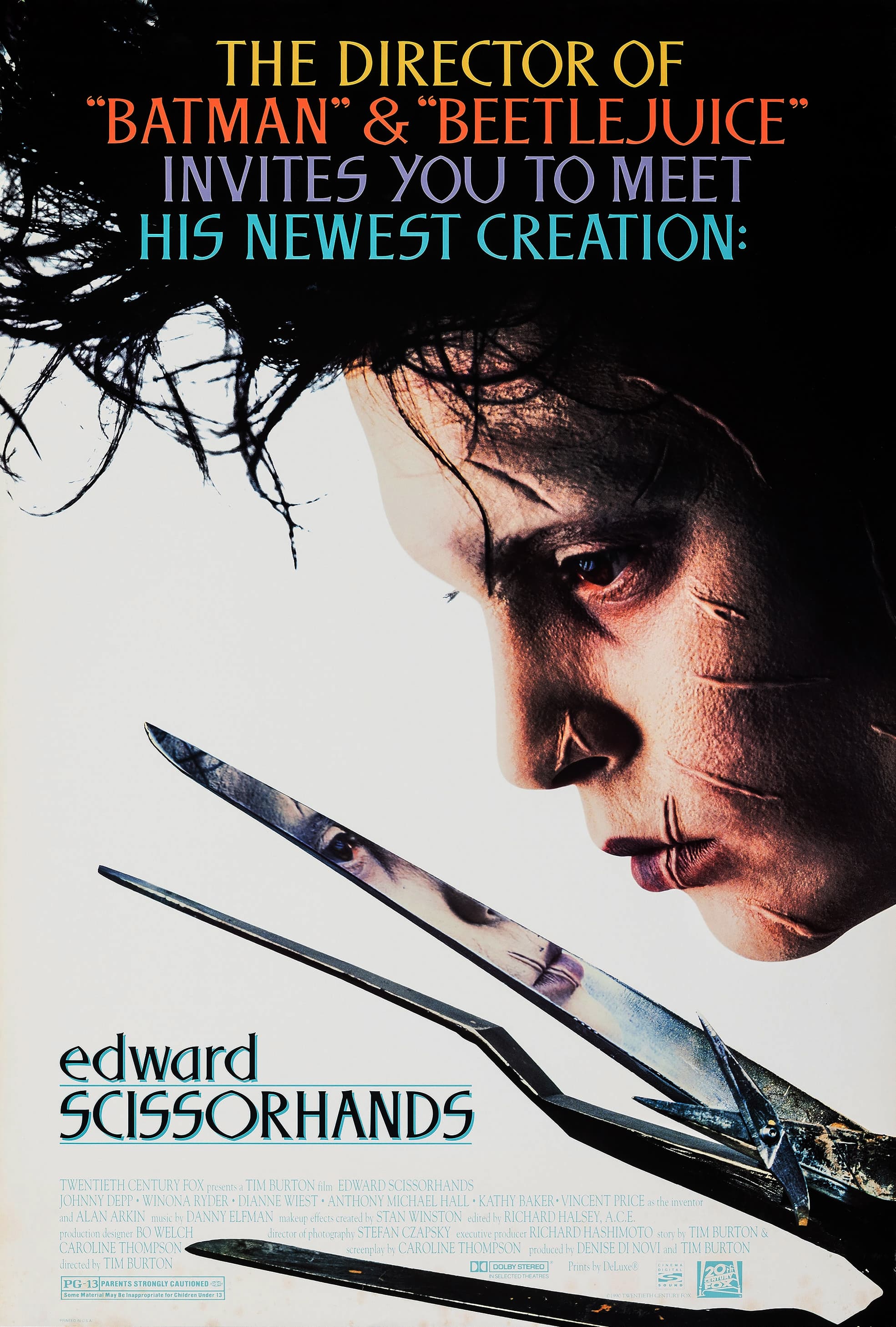
Edward Scissorhands
A fairy tale about a man who can’t quite touch the world — and the neighbourhood that can’t quite handle him.
// The setup
PLAYBACK STARTED
Tim Burton’s Edward Scissorhands tells a story you can spot from across the street: a strange, fragile outsider is carried into tidy suburbia and everything that seems pleasant on the surface gets complicated. It’s a romantic, Gothic fable framed as an older Kim Boggs telling her granddaughter about Edward, the man with scissors for hands — and that storytelling frame keeps the film feeling like a remembered parable rather than just another studio picture.
THE MOVIE
Edward Scissorhands is still the reason this movie works
You know the image: a pale, haunted figure with scissors where fingers should be, not built to belong. The story is told — deliberately — like someone remembering a strange kindness. An older Kim Boggs recounts Edward’s life to her granddaughter, which keeps the whole thing in the realm of memory and myth rather than slice-by-slice realism.
Peg Boggs, an Avon saleswoman, is the practical hinge. She finds Edward living alone in a Gothic mansion and brings him home. That single act of bringing the outsider into the street is the film’s heartbeat: it’s where curiosity, generosity and trouble all begin.
Edward himself wants the obvious thing: connection. He is cautious and gentle, shaped by an incomplete social education from the Inventor, and his hands — literally scissors — are both his gift and his handicap. Put that together and you get a cinematic fairy tale that’s small enough to feel intimate and odd enough to linger.
THE SETUP
The idea that sets Edward Scissorhands in motion
The film is careful with its premise. It opens as a story being told — an older Kim Boggs remembering Edward — which keeps the plot feeling like folklore rather than a checklist of events.
That premise buys the movie room to show small wonders: Edward turns his scissors into tools for topiary sculpting, hair styling and dog grooming. These aren’t tricks for spectacle so much as invitations to the neighbourhood: he offers skill, beauty and novelty.
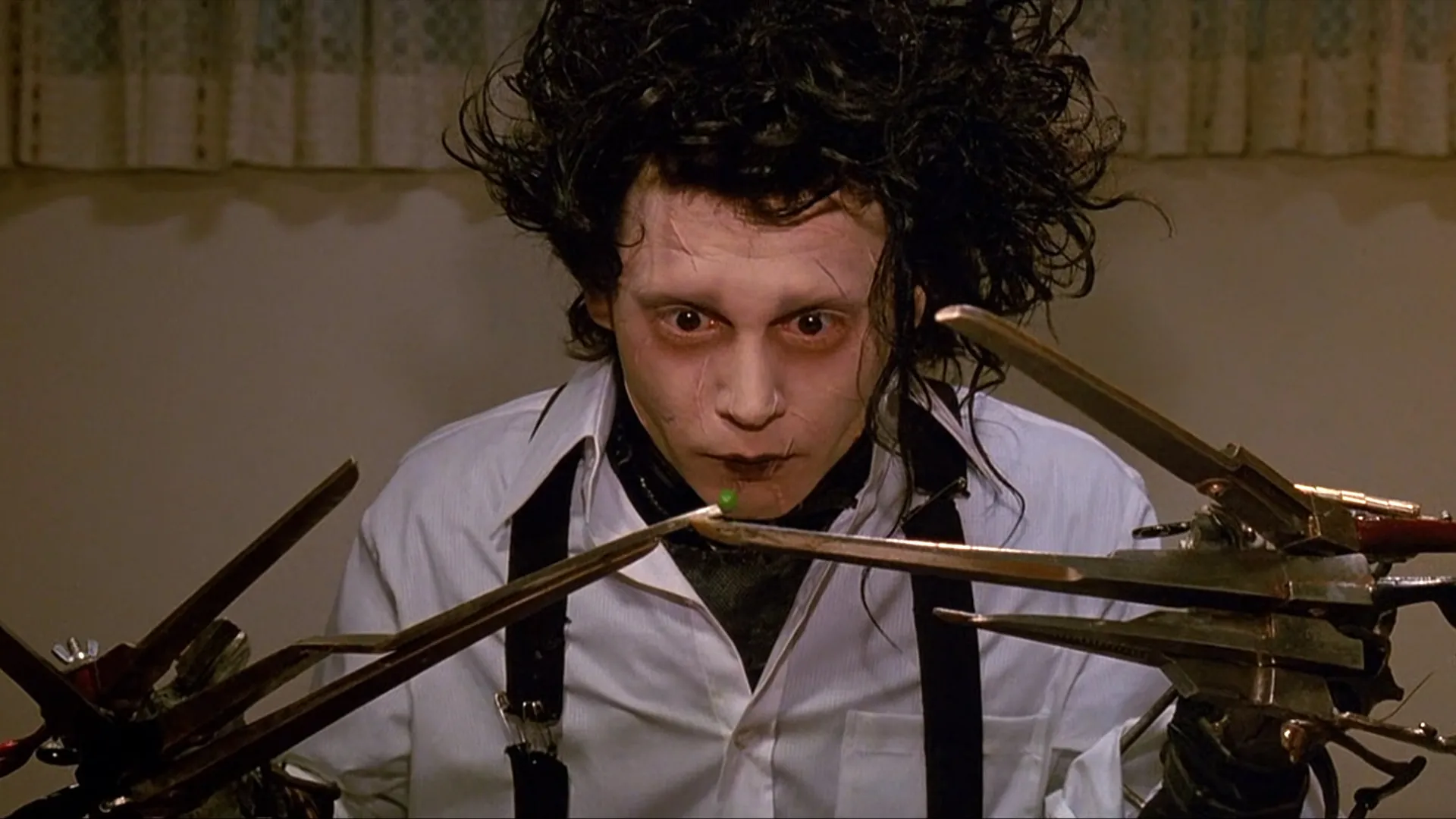
The central conflict is less about a conspiracy than bad timing and social shortness of breath. Neighborly curiosity curdles into suspicion through misunderstandings; the same hands that create also make Edward dangerous in the eyes of the community.
Caroline Thompson’s screenplay — from a story by Thompson and Tim Burton — keeps the setup tight: a single act of rescue, a short-lived period of acceptance, then the slide into fear and exile. It’s simple, and that simplicity is a strength.
THE CHARACTER
Why Edward Scissorhands matters
Edward as a figure is tidy in his contradiction. He can cut and shape things with astonishing delicacy, yet he’s physically ill-suited to ordinary touch. That contradiction gives the character a clear, sympathetic logic: his gifts and limits are the same thing.
Kim Boggs matters to him and to the film because she becomes the measuring stick for the town’s decency. Her relationship with Edward shifts from fear to affection to a kind of protection that keeps the story anchored in human terms.
The casting fact is simple: Johnny Depp plays Edward. The character’s potency comes from what he’s allowed to be on the page — an unfinished, wordless presence who forces the neighbourhood to show its colours — not from a parade of external plot devices.
Tim Burton’s hand is obvious in the character’s contours: Edward is written as a fairy-tale outsider, and the film keeps him close to that archetype rather than turning him into a conventional hero.
THE PERFORMANCE
Why Johnny Depp's performance matters
Contemporary reviewers homed in on Depp as a central strength for a reason: Edward is written to communicate more with stillness and movement than with speech, and the film needed an actor who could do that convincingly.
What critics at the time noticed was Depp’s largely nonverbal expressiveness — the way physical choices carry emotion when the character rarely speaks.
That casting choice matters because a lot of the movie’s emotional work depends on the audience being able to read Edward without a running commentary. If that connection fails, the whole fable risks slipping into oddness for oddness’ sake.
So, on the film’s own terms, Depp’s contribution is less about star wattage and more about fitting the role the screenplay required.
UNDER THE SURFACE
Edward Scissorhands has more on its mind than the plot suggests
The film wears suburban cheerfulness like a mask. That bright surface—friendly lawns, neighbourly chatter—sits over a core of intolerance and quick judgment. The movie keeps reminding you that conformity can be savage in its small cruelties.
At its heart there’s a simple outsider-versus-community story: someone who is different arrives and a neighbourhood’s tolerance is tested. It’s not a slow burn; it’s a spiral: curiosity becomes ownership, then suspicion, then hostility.
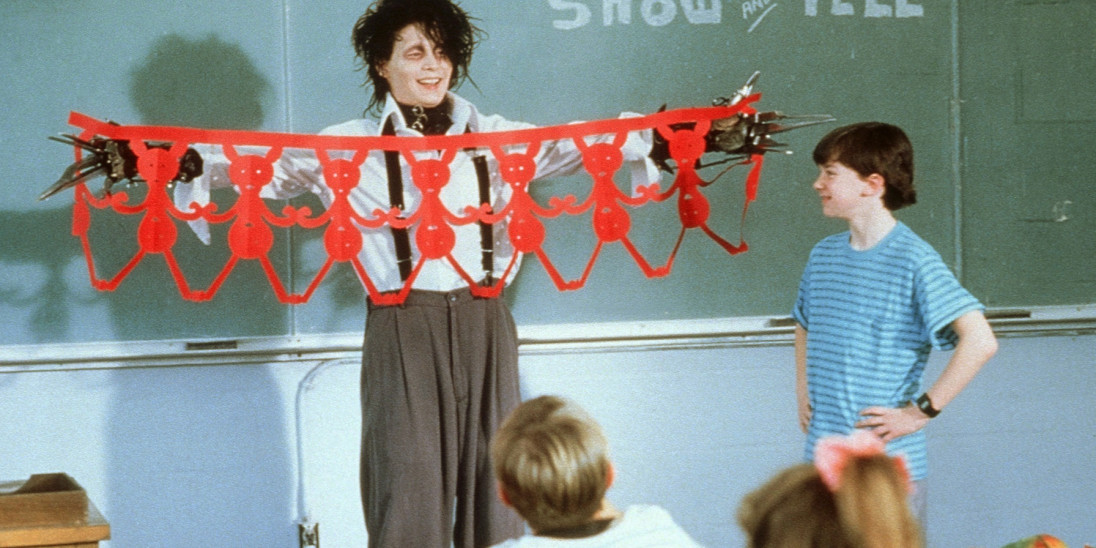
The Frankenstein link is deliberate. There’s a creator and an unfinished creation; the Inventor dies before Edward is complete, which turns a human-made being into a figure the town can’t place. Mob-against-monster dynamics show up not as melodrama but as an ugly inevitability when fear finds a target.
Finally, the film plays like a fairy tale remembered — innocence and the misunderstood artist sit beside mythmaking. Edward’s sculpting and styling turn him into both craftsman and spectacle, which makes the neighbours alternately adore and vilify him.
THE FILMMAKING
How Edward Scissorhands was put together
The film’s visual identity was a team effort anchored by production design. Bo Welch is credited as production designer and the look of the film — its contrasts, its shaped suburban world — is part of what people still remember.
Stefan Czapsky is listed as cinematographer, and production records note the technical choices such as Panavision lenses and cameras. Those are the nuts and bolts that let Burton’s gothic sensibility sit inside a mainstream studio format.
Recognition followed; Bo Welch received a BAFTA for Best Production Design, which is the sort of practical acknowledgment that the film’s visual imagination was doing something notable within the industry.
Put simply: the movie feels like a modern fairy tale because the production decisions were aligned around that goal — to make suburbia look as staged and uncanny as a storybook street.
PRACTICAL EFFECTS
The effects work that gives Edward Scissorhands its physical personality
Edward’s hands are not a digital invention. Stan Winston Studio built the scissor-hand prosthetics used on set, and several versions — metal and plastic — were employed depending on the needs of a scene.
Contemporary production notes mention the blades for some versions measured about ten inches, and Depp used different hand assemblies to suit different shots. Those choices matter: they’re the physical compromise at the heart of Edward’s presence.
The topiary sculptures Edward creates are also extensively practical. Large metal armatures were covered with thousands of plastic plant sprigs to achieve those stylised shapes, which makes them read as handmade curiosities rather than ephemeral props.
All of this is important because the film depends on tactility — on things you can believe someone could actually shape or break. The effects work keeps Edward’s world tangible.
PURE 80S
Edward Scissorhands could not belong to any other decade
Edward Scissorhands sits at a particular moment when Tim Burton’s gothic-fantasy bent was being folded into big-studio filmmaking. It’s the late-1980s/early-1990s mainstreaming of his style: odd, romantic and studio-backed.
That timing helped the film get made. The project was developed and greenlit after Burton’s commercial breakthrough with Batman (1989), which affected the film’s financing and studio support.
The movie also marks a turning point in personnel: it’s the first feature collaboration between Burton and Johnny Depp that led to a long-term director–star partnership through the 1990s and beyond.
So the film feels of its moment because it’s both a personal fable and a studio picture — a compromise that, in this case, made something rather singular.
THE LEGACY
Why Edward Scissorhands still matters
The film collected formal recognition: it won the 1991 Hugo Award for Best Dramatic Presentation and Bo Welch picked up a BAFTA for Best Production Design. Those are the kind of markers that say the industry noticed both its storytelling and its look.
More practically, Edward Scissorhands started the Burton–Depp partnership that would define much of Burton’s 1990s output. That collaboration helped shape a strain of mainstream fantasy that mixed oddball vision with recognisable emotion.
There’s also an odd footnote: Vincent Price’s brief appearance as the Inventor was among his last feature film performances released during his lifetime. It’s a small, elegiac detail that suits a film wrapped in memory.
Taken together, the awards, the collaborations and the casting choices explain why the movie has remained a steady reference point — not by hubris, but by the particular things it chose to do well.
THE VERDICT
Does Edward Scissorhands still hold up?
Yes — if you want a fairy tale that trusts shape and silence as much as dialogue. The film is told as an older Kim Boggs remembering Edward, which keeps the emotion arranged like a memory rather than a lecture. That framing helps when the story asks you to accept an unfinished man with scissors for hands as its centre.
On the evidence in the film, the pieces fit. Peg Boggs brings Edward into suburbia; he quickly shows genuine creative gifts — topiary, hair and pet grooming — and those gifts are inseparable from the limits that make him an outsider. The screenplay keeps that tension tight: admiration turns to suspicion, and the community’s reaction drives the drama.
Johnny Depp is the face of that tension, and Edward is written as someone who wants connection but can’t easily take it. Peg acts as his protector; Kim becomes the person whose care and fear chart the neighbourhood’s conscience. Those are straightforward, human elements that still land.
So should you watch it now? If you respond to a well-made modern fable — one that mixes gothic oddness, suburban pettiness and a clear emotional throughline — Edward Scissorhands still rewards. It doesn’t try to be everything; it chooses a mood and a moral, and it mostly keeps faith with them.
Share this movie
// Keep watching
More movies from the 90s
If Edward Scissorhands is your kind of movie, there's plenty more on the shelves worth rewinding.
1990 // VHS
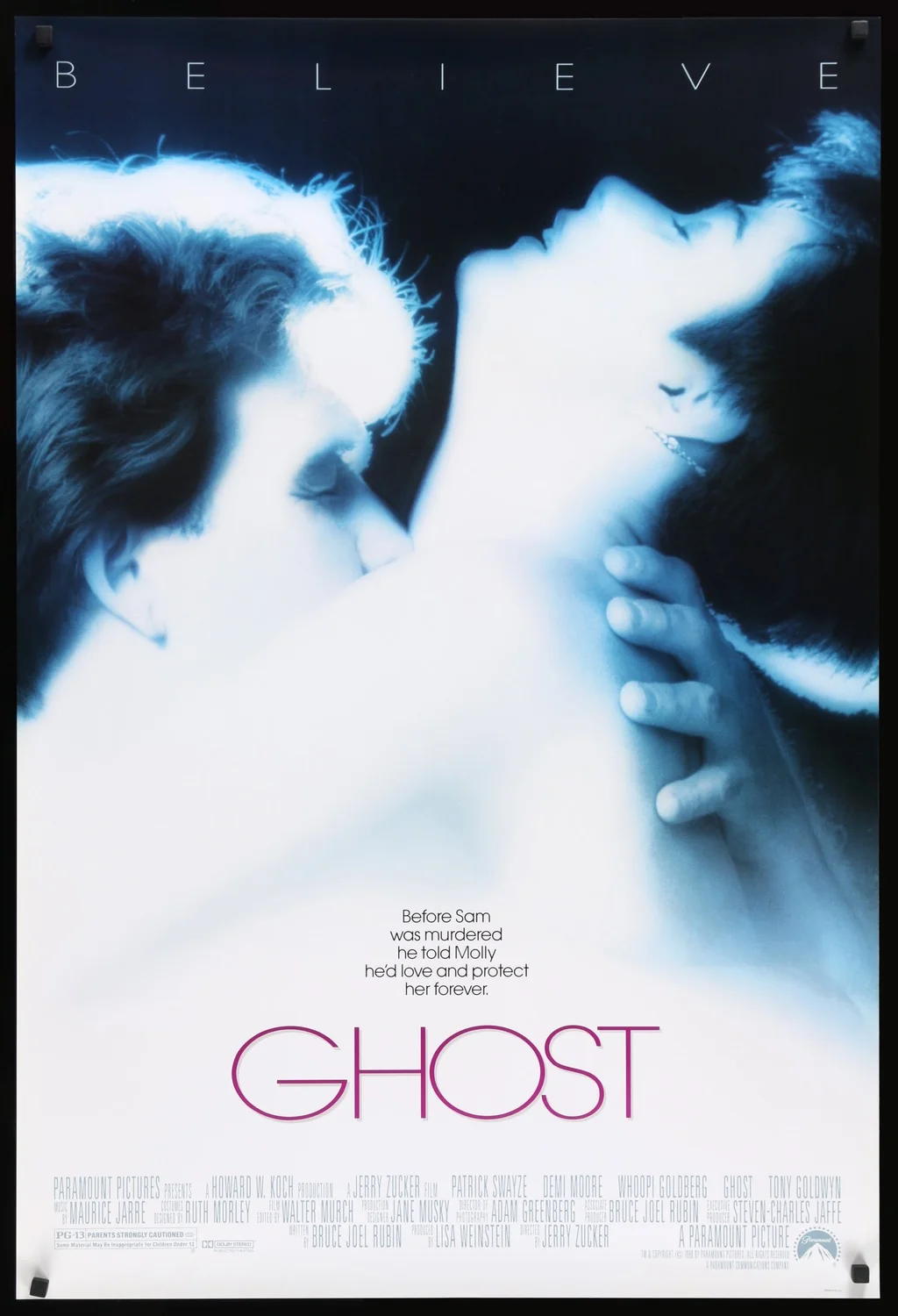
Ghost
A murder mystery disguised as a love story — with a man who won’t stop watching over the person he loves.
1990 // VHS
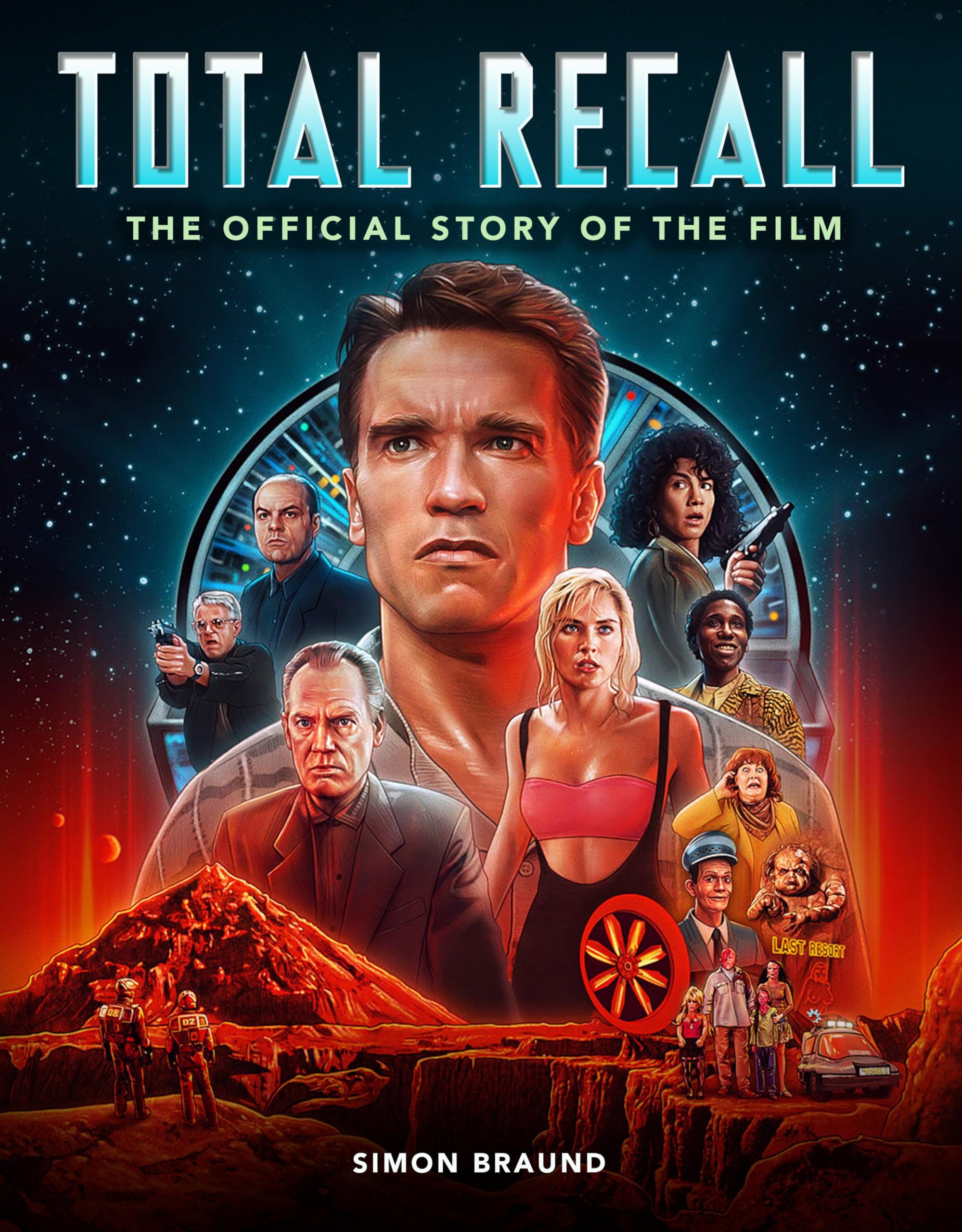
Total Recall
Memory, muscle and a very faulty holiday package — with Mars on the itinerary.
1990 // VHS
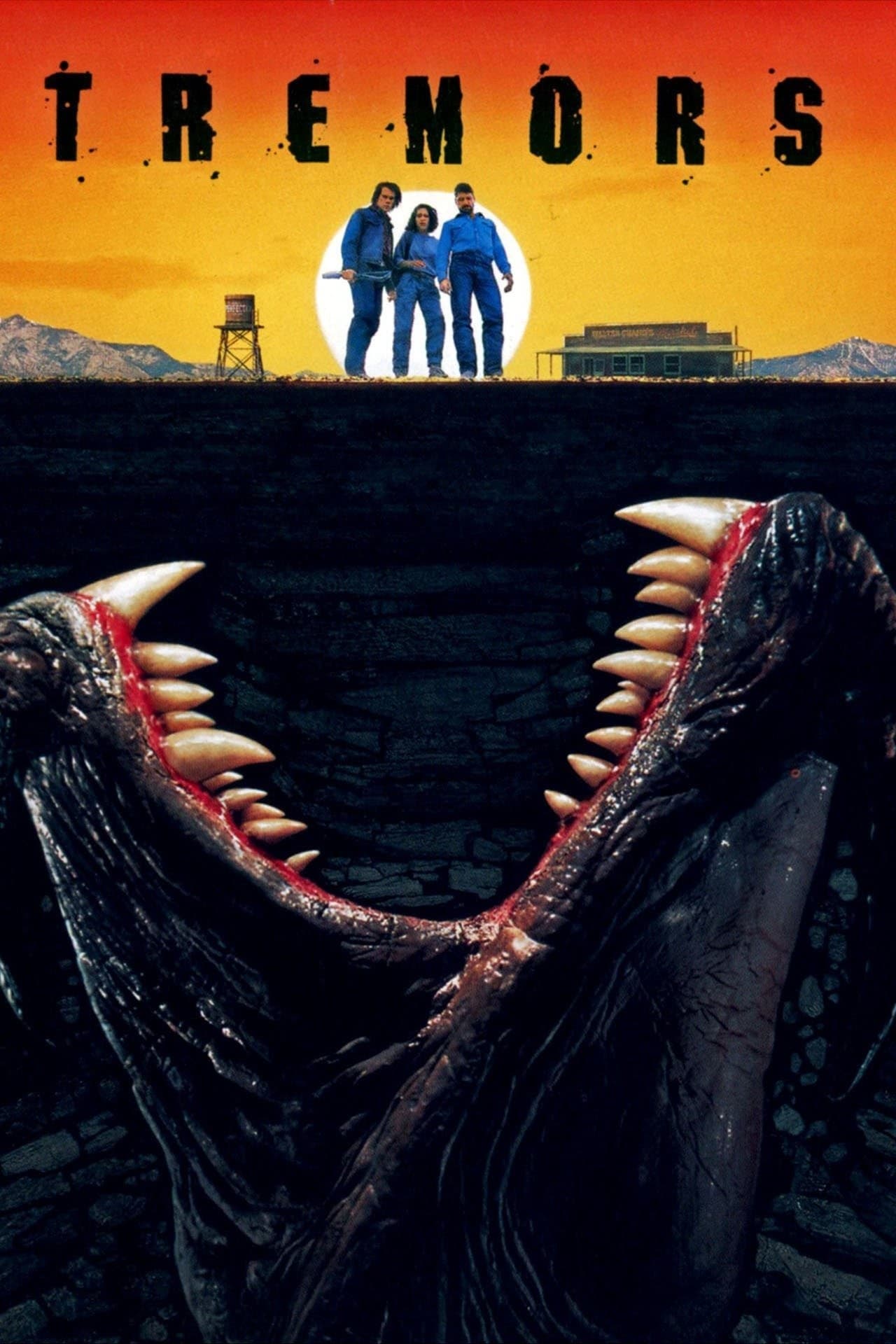
Tremors
Handymen, Graboids and small‑town stubbornness — Tremors is a monster movie with a practical heart.