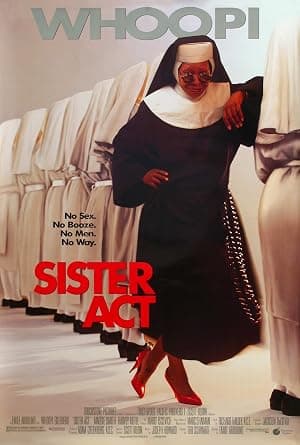
Sister Act
A nightclub singer in a habit who turns a sleepy convent into a choir — and makes you clap.
// The setup
PLAYBACK STARTED
Sister Act hooks on a single, silly idea: a lounge singer hides out in a convent and proceeds to upset the furniture. It’s the kind of premise that sounds daft on paper and oddly irresistible on screen. What keeps it rolling is how the story lets that fish-out-of-water joke expand into something bigger — noisy, warm and surprisingly insistent about music and belonging.
THE MOVIE
Deloris Van Cartier / Sister Mary Clarence is still the reason this movie works
You can sell Sister Act as a musical comedy — and it is — but the real pitch is simpler: a nightclub singer ends up hidden in a convent and proceeds to cause charming chaos. Deloris Van Cartier arrives under a witness-protection alias and everything inside those walls has to rearrange itself to fit her.
She doesn’t come as some saintly convert. At first she’s surviving. Then, in the most enjoyable pivot, her talent and impatience turn into a force for the choir and the neighbourhood. That shift — from self-preservation to communal drive — is the engine that keeps the film moving.
It’s 1992 Emile Ardolino territory: a 100-minute comic-musical with Whoopi Goldberg at its centre, supported by a cast that includes Maggie Smith and a handful of memorable nuns. That cast and the film’s mix of comedy and music are what make the premise feel fresh instead of flimsy.
THE SETUP
The idea that sets Sister Act in motion
The film keeps its shape tight: Deloris must stay hidden, and her very presence troubles the convent’s routine. That basic tension — hide and don’t get noticed versus shake things up — is the plot’s constant tug.
What gives the movie its forward motion is music. Deloris uses her secular background to reorganise the failing choir, modernising their approach so the services draw people back in and the parish starts buzzing again.
Because music here is also a story machine, it’s used to change characters as well as crowds. A shy nun grows into a lead singer. The convent’s profile shifts from sleepy to noticed, which solves practical problems and creates new ones.
Tension returns when Deloris’s cover is compromised: an episode of kidnapping pushes the nuns and the local police into a direct confrontation with the mob, reminding the film that its comedy sits next to genuine stakes.
THE CHARACTER
Why Deloris Van Cartier / Sister Mary Clarence matters
Deloris is the movie’s disruptor-in-chief. She arrives as a lounge singer with a target on her back and an instinct for spectacle; hiding in a habit is a practical solution that also makes for excellent cinema.
Her arc is neatly economical: what starts as survival becomes generosity. Once she realises the choir can be something more than a dutiful ritual, she invests energy and ideas — and that investment reshapes the convent’s purpose.
That change isn’t only practical. Several of the sisters respond to Deloris personally: the painfully shy nun who becomes a confident lead is the clearest example of how Deloris’s worldliness translates into other people’s courage.
Even the Reverend Mother, the convent’s rule-minded authority, moves from skepticism to a form of respect. The movie stages that evolution as small compromises and big music moments rather than grand sermons.
UNDER THE SURFACE
Sister Act has more on its mind than the plot suggests
On the surface it’s a fish-out-of-water comedy. Underneath, it’s about outsider-integration — what happens when a stranger with something to offer arrives in a closed community and refuses to accept the old rules.
Music is the film’s practical and emotional glue. Reworking the choir becomes a way to transform the parish: more people come, relationships shift, and the convent’s role in the neighbourhood becomes active rather than passive.
Identity and disguise are playful here. The habit is literally a cover, but the disguise lets Deloris try on a different life and, in doing so, helps the nuns try on parts of themselves they had set aside.
There’s also a small argument about authority versus change. The Reverend Mother represents order; Deloris represents disruption. The movie enjoys that tension and resolves it by nudging the convent toward a new, livelier equilibrium.
THE FILMMAKING
How Sister Act was put together
One of the film’s simplest production moves is also one of its smartest: the staging and production design treat the convent and the musical numbers as two different atmospheres. The everyday interiors feel subdued so that the choir scenes can pop.
That contrast turns the musical moments into small events rather than background decoration. When the sisters sing, the world inside the film visibly shifts — the neighbourhood notices, and the story keeps moving.
It’s a clear-directing choice: present routine with restraint, present performance with energy. The effect is comic and emotional at once; the congregation’s reaction becomes part of the joke and the payoff.
Because the film keeps those spaces distinct, the changes the choir brings feel earned. The convent’s transformation reads as a series of choices rather than the result of a single gag.
PURE 80S
Sister Act could not belong to any other decade
Sister Act sits very much in the early-1990s studio playbook: a broadly accessible, family-friendly comedy built around a recognisable star and musical set pieces. That mix is part of why it felt like a reliable outing for audiences of the time.
The casting and the tone aim for cross-demographic reach rather than niche cool, which is why the film balances jokes, community warmth and clear musical beats — a formula that studios favoured for dependable returns.
Being of that mould is not a criticism. It explains why the film is so careful to keep its emotional beats clean and its musical moments immediate: everything is designed to be understood and felt quickly.
In short, Sister Act’s personality is very much that early-1990s blend of star vehicle plus family musical, and the movie leans into that comfortable, crowd-pleasing identity.
THE LEGACY
Why Sister Act still matters
Sister Act’s afterlife is pragmatic rather than mythical. It generated a direct sequel that reunited the principal players, which says the original had enough momentum to keep the characters going.
It also found a second life on stage: the story was adapted into a theatrical musical that moved from regional houses to the West End and Broadway, with the original film’s star among the producers — proof that the core idea translates beyond the screen.
At the time, the film’s mix of comedy and music earned it serious recognition: Golden Globe nominations for Best Motion Picture – Musical or Comedy and for Whoopi Goldberg as Best Actress.
Taken together, these follow-ups show that Sister Act wasn’t just a disposable studio joke; it offered a sturdy concept that could be reshaped for different platforms and audiences.
THE VERDICT
Does Sister Act still hold up?
Yes — if you come for the premise and stay for the warmth. The film’s engine is simple: a lounge singer witnesses a murder, goes into hiding as Sister Mary Clarence, and her presence disrupts a quiet convent in ways that are funny and, eventually, useful.
Because the story balances personal danger with community uplift — kidnapping and mob tension sit beside choir rehearsals and newfound confidence — it never settles for being a one-note gag. Deloris’s initial motive of survival evolves into an earnest drive to help the choir and the parish.
That evolution is what saves the film from being merely a novelty. The movie repeatedly uses Deloris’s musical know-how to modernise the choir, which produces both practical benefits for the parish and believable character change in the nuns and in the Reverend Mother.
If you haven’t seen it in years, it still feels like a neat, well-made piece of studio entertainment: clear in purpose, economical in storytelling, and cheerfully loud when it needs to be. In short, Sister Act works because it turns a disguise into a doorway — and then invites the whole neighbourhood in.
Share this movie
// Keep watching
More movies from the 90s
If Sister Act is your kind of movie, there's plenty more on the shelves worth rewinding.

1999 // VHS
10 Things I Hate About You
Sibling rules, a rooftop serenade and one very stubborn Kat — Shakespeare in a school corridor.

1999 // VHS
American Beauty
Lester Burnham, suburban rot and a midlife argument that still stings.

1999 // VHS
Any Given Sunday
Al Pacino's coach anchors the chaos of a film about football turned into product — loud, messy and oddly persuasive.