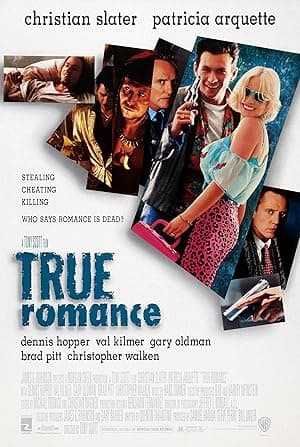
True Romance
A road movie that thinks it’s a love letter — with bullets through the envelope.
// The setup
PLAYBACK STARTED
True Romance arrives like someone’s most dangerous mixtape: sentimental, loud and slightly unhinged. Tony Scott and Quentin Tarantino hand the story to Clarence Worley — a comic‑book-obsessed Elvis fan — and what begins as a bizarre, earnest love match turns into a series of violent detours that never quite lose sight of its oddball heart.
THE MOVIE
Clarence Worley is still the reason this movie works
What makes True Romance worth revisiting isn’t just the blood and the one‑liners; it’s that at the centre of all the chaos is Clarence Worley, a comic‑book shop clerk and Elvis obsessive who walks into a life he didn’t know he wanted. He meets Alabama Whitman and, in a film that won’t pretend love is tidy, decides to build a future with her.
From that meeting an early violent confrontation — and later a suitcase of cocaine — propel Clarence and Alabama into a fugitive groove. The film chooses escalation over slow simmer: one collision with criminal figures leads to the next, and their romance becomes the engine that keeps them moving through it all.
Tony Scott directs with the kind of energy that makes 117 minutes feel like a sprint: glossy, restless, and frequently flirtatious with pulp. Christian Slater plays Clarence and Patricia Arquette plays Alabama; around them Scott assembles a supporting cast that helps the movie trade in both danger and an oddly sincere idea of redemption.
THE SETUP
The idea that sets True Romance in motion
At its most basic, True Romance is straightforward: Clarence meets Alabama, they fall in love, and decide to start a life together. That simple, almost innocent seed is what the rest of the movie keeps circling back to.
Of course, the story doesn’t stay cosy. Incidents early on — including a violent row with Alabama’s pimp and the transfer of a suitcase full of cocaine — throw the couple into direct conflict with criminal elements and organised crime. Those beats are what make the film a couple‑on‑the‑run tale rather than a quiet, private drama.
Tony Scott remodelled Quentin Tarantino’s original non‑linear blueprint into a largely linear timeline; what remains is a chain of set pieces, each one a different test for the pair. The film prefers these episodic escalations over a single long chase, so the narrative moves from one combustible encounter to another.
Patricia Arquette’s voice‑over bookends the film, giving the story a personal frame. That narration reminds you who this story belongs to, even when the action threatens to steal the show.
THE CHARACTER
Why Clarence Worley matters
Clarence is the movie’s odd combination of dweeb and doer. He’s introduced as a comic‑book shop clerk with a deep fondness for Elvis and pop culture; those details could have just been window dressing, but they help explain why he wants the kind of fairy‑tale life Alabama offers.
He’s also someone who will violently defend that picture of a future. That willingness to turn extreme in defence of a private dream is what keeps the plot moving — and what makes him more than a passive romantic figure.
Because Clarence’s identity is stitched from pop‑culture markers, his decisions feel like an attempt at self‑reinvention. The movie makes you believe the odd couple’s fantasy of starting over, even while it keeps testing whether that fantasy can survive the concrete world they’ve stumbled into.
Put plainly: Clarence matters because he’s the bridge between earnest fantasy and ugly reality. The film needs a character who can believe in an ideal and also act on it, and that’s Clarence’s job.
UNDER THE SURFACE
True Romance has more on its mind than the plot suggests
Beneath the guns and set pieces, the movie is fascinated by how pop culture shapes a person. Clarence’s Elvis fixation and comic book life aren’t random — they’re the materials he uses to author himself. That makes the film feel less like a clumsy homage and more like a portrait of identity built from borrowed icons.
It’s also very much a couple‑on‑the‑run movie. The thrill comes from two people trying to carve out a private life while the outside world refuses to leave them alone. The road in this film is less geography and more pressure cooker.
Romance in True Romance isn’t sentimental filler. It’s the motivating force: a redemptive, idealised love that survives in spite of pulp‑style violence. The shock of that collision — love framed by brutality — is the film’s emotional gamble.
Finally, the movie wears its pastiches on its sleeve. It nods to earlier crime‑romance films while remixing their language with Tarantino’s pop‑saturated dialogue. That mixture of homage and pastiche gives the film its particular flavour: part cinephile wink, part full‑tilt melodrama.
THE FILMMAKING
How True Romance was put together
One of the film’s most obvious signatures is how it looks. Credit for that goes to Jeffrey L. Kimball as director of photography: his work helps give the movie a saturated, kinetic sheen that sits neatly with Tony Scott’s late‑80s/early‑90s sensibility.
That visual push matters because it turns pulp into spectacle. Scenes that could have played as low‑budget grit instead feel heightened — not just darker, but louder and more emphatic.
Scott’s direction and Kimball’s lensing combine to keep the movie moving. The filmmaking choices steer the audience through episodic confrontations rather than pausing for quiet reflection.
So while Tarantino’s script supplies the talk, the production’s look supplies the shove: True Romance is a film that wants you along for the ride, whether you’re ready or not.
PRACTICAL EFFECTS
The effects work that gives True Romance its physical personality
When the film turns violent, it does so with straightforward, conventional stunt and squib work — the kind of practical techniques common to early‑1990s crime pictures.
There aren’t claims of bespoke or groundbreaking effects here; instead, the movie uses established physical methods to sell impact and maintain a sense of consequence.
That approach keeps the action feeling grounded: when things go wrong, they look and sound like actual collisions rather than stylised trickery.
Put another way, the physical effects do their job without calling attention to themselves. They give the film a necessary tactile bite and let the story’s tonal swings land.
PURE 80S
True Romance could not belong to any other decade
True Romance sits at a crossroads between two 1990s tendencies: Tarantino’s indie, pop‑culture–saturated screenwriting and the studio gloss of a director who came up in late‑80s action cinema.
That collision — scrappy, referential writing meeting a high‑production sheen — was very much a 1990s thing. Contemporary reaction noticed how the film’s verbal pastiche and glossy visuals kept bumping into one another.
The result is a picture that feels of its moment: neither purely art‑house nor pure mainstream, but a hybrid that borrows the energy of both worlds.
In other words, the film’s style is an honest product of its year. It’s 1993 in choices, attitude and the willingness to mix genres and tones without apology.
THE LEGACY
Why True Romance still matters
Part of the film’s staying power is its script: an early Quentin Tarantino screenplay that helped lift his profile and became a touchstone in conversations about 1990s crime cinema.
There’s also the ensemble — a cast full of names who either were already noted or would go on to larger careers. Contemporary coverage and later career retrospectives regularly point to this film when charting actors’ early moments.
Finally, the score by Hans Zimmer and its deliberate musical reference to Badlands is often picked out in discussions about the film’s tone. That choice keeps the movie in critical conversations: it’s not just violence and dialogue, but a film aware of its musical and cinematic lineage.
Taken together, those elements explain why True Romance remains a film people return to: it’s a meeting point of a notable writer, a high‑energy director and a cast that gave the story texture beyond its central couple.
THE VERDICT
Does True Romance still hold up?
Yes — if what you’re after is an energetic, character‑driven churn of romance and pulp. The film’s premise is simple: Clarence meets Alabama, they fall in love and try to start a life together. That emotional clarity keeps a lot of the film’s excess anchored.
The plot’s momentum comes from a series of escalating confrontations — beginning with a violent run‑in involving Alabama’s pimp and later a suitcase of cocaine — which thrust the couple into direct conflict with criminal figures and organised crime. The movie prefers these episodic set pieces to a single long chase, and that choice gives it a stop‑start dynamism.
On the formal side, the film’s largely linear structure (Tony Scott flattened Quentin Tarantino’s original non‑linear layout) and Alabama’s framing voice‑over help the story remain readable even when the action grows loud. Clarence’s pop‑culture identity and his willingness to fight for a shared future keep the couple emotionally believable within the film’s heightened world.
If you enjoy films where romance is a sincere, motivating force rather than mere ornament, True Romance still pays off. It’s loud, occasionally reckless, and full of grabby performances and production choices — but beneath that, it’s stubbornly about two people trying to rewrite themselves together.
Share this movie
// Keep watching
More movies from the 90s
If True Romance is your kind of movie, there's plenty more on the shelves worth rewinding.
1993 // VHS
Schindler's List
A businessman who keeps a list — and keeps changing the kind of man he is.
1999 // VHS
10 Things I Hate About You
Sibling rules, a rooftop serenade and one very stubborn Kat — Shakespeare in a school corridor.
1999 // VHS
American Beauty
Lester Burnham, suburban rot and a midlife argument that still stings.